Tag: 1908

  • 29 October 2018 Korea

    Monday  29 October 2018
    Monday or maybe Tuesday

    Have we crossed the date line? I do not recommend taking a 5am flight to Korea or a 5am flight to anywhere. It means waking up at 2am to be at the airport at 3am, the required two hours before departure time. Fortunately, the Medford, Oregon, airport is small, and one can arrive at 3:30 or maybe even 4am and make it through Security and still be on time. Regardless, on the night before travel I am up at 2am, unable to go to sleep for fear of failing to wake up on time and/or dealing with the Surprise.

    An unwritten law assures that no matter how long preparations for a long trip have been made, just prior to the last hours or the last day of leaving, there will be a Surprise. Surprises can be good, but good or bad, they assuredly obliterate the time required for planned preparations and ensure that one will not have the luxury of sleep prior to the hour of departure.

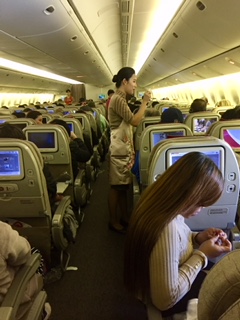
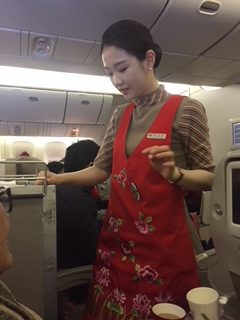
    I also do not recommend sleeping or trying to sleep on the floor of the Seattle Airport during the very long six-hour layover between arriving at Seattle and departing for Seoul. But once loaded up and on board, I certainly can recommend Asiana Airlines. What an experience it is to fly in a beautiful airplane, with wide seats that really recline, the soft cushions a lovely tan, accented with soft rust colored pillows and darker tan blankets, a lovely palette of color, and this in economy class! No full figured stewardess here, but perfectly coiffed black haired young women dressed in elegant form-fitting suits, just a splash of color with the small scarf at the neck. When the women added the soft red aprons sprinkled with a flower splash design on the front – there were two types of aprons, one red and the others tan – I presume this didn’t indicate status but merely variation for the sake of elegant variety.
                        

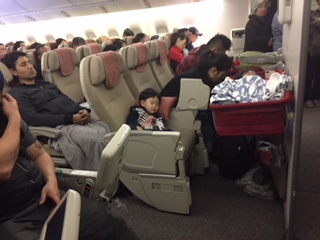
    Lots of children on board, and against a bulkhead just in front of the parents were two bassinets for sleeping babies.

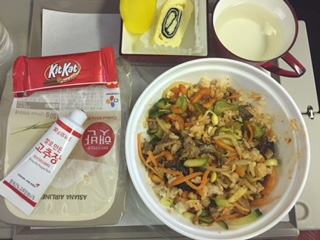
    And then we had dinner, a choice of beef steak and mashed potatoes or Korean Bibimbap. My Japanese seat-mate asked for chopsticks with which to eat her beefsteak, but she was told chop sticks were not offered with beefsteak. In fact, chopsticks were not offered with Bibimbap either, but directions were. I was too excited to realize I should should take a photo of the vegetables before I mixed them with the rice and hot sauce. The steward recommended that I add only half the tube of the hot sauce. I added a soupçon, and that was more than enough. You can see how the mixed rice and vegetable look, and it was quite good. The pickles were daikon pickles similar to those my Japanese friend Tsutae San makes with rice vinegar, and they were delicious. The seaweed soup was so good, but just looks like clear water in life and also in the photo. Dessert was a universal KitKat bar, a bow no doubt to American taste – though the Koreans apparently love sweet things and put sugar on a grilled cheese sandwich.
              

    Breakfast this morning was a chicken sandwich with a bit of onion and more fat roll than chicken, so good enough, and the lights have not been turned on, perhaps we are coming close to Incheon.

    And so off to Korea, rather unprepared. The Surprise comes, Living things must be taken care of always. The plants must be watered and the dog must be fed. This means shopping and then there is sleeping and paying taxes and the Other that knocks out the rest of the time to be devoted to preparations for a trip to Korea. At least I know how to say “thank you” and “excuse me”. During the next ten days, surely I will learn more, maybe even catch up with all I had planned to do earlier. Somehow, it all works out.

    Best wishes,
    Miriam
  • 28 October 2018 Korea November 2018

    Sunday  28 October 2018
    Preparing for Korea In Ashland, Oregon

    This begins the account of my upcoming  ten days in Korea during November 2018.

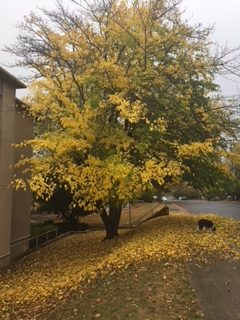
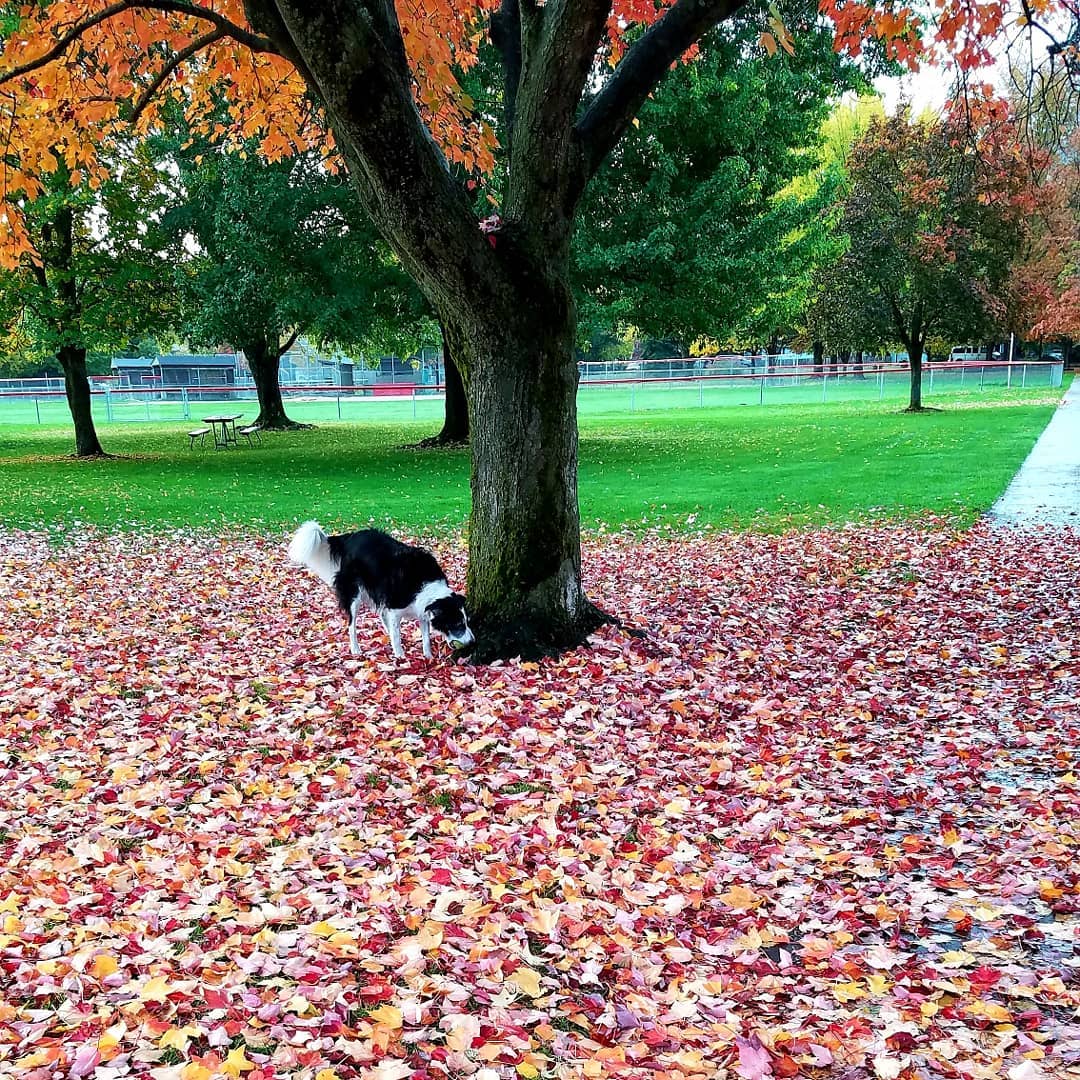
    Why would I want to leave Ashland at this beautiful time the year? The fall colors have never been more beautiful, and when I return, the trees will all be bare. But I hope I will return better able to discuss the culture and activities of Korea in 1908 – which is the purpose of this trip: to research the history of Korea and perhaps catch a glimpse of what the Gambles saw when they were making their visit there over a century ago.

    Thank you for reading. Send any questions you may have. Enjoy the fall colors that I am missing.

    Best wishes,
    Miriam

    `                       

  • 5 November 2015 Thursday Grand Canal Museum & West Lake

    杭 HANGZHOU

    Thursday  5 November 2015

    Good Professor Shen arrived with taxi at 9:30. Off we tore into the traffic. I must look up the accident rate. How can these people not have an accident every block? But, no. Cars skim by each other, always within inches of each other. as do bicycles; scooters; small motor bikes; electric tricycles loaded with piles of lumber, long poles and 2x4s that poke perilously fore and aft the driver’s already overloaded load that sits next to behind his head. I saw very few buses, and no wonder. There is scarcely room for larger vehicles on many of the smaller streets. Small streets and boulevards and freeways are always jammed, not a finger’s width of space between bumpers. ‘and I am told Beijing is far worse.

    Two taxi drivers share a cab, twelve hours for each man. The car never sleeps. With Hangzhou and other incursions from upstarts, the certified taxi drivers are suffering, working harder than ever for less money. The certification involves a long study period and a stiff exam, but now, once acquired, the certification apparently does not ensure a good income.To drive twelve hours a day in this traffic would, I should think, leave the driver with an ongoing nervous breakdown, but, no – they keep on driving. 

    And the throngs of people to drive through and between and behind. We drove for what seemed hours through people and more people and more people, in that part of town people appear well-dressed and happy or even ill-dressed but happy. Outside our Bokai Hotel is an ongoing card game around a small table set on the edge of the sidewalk, overhung with a cloud of cigarette smoke, the onlookers and the players joking, involved, joshing; the participants vary, but the game goes on.

    The streets are so busy, people and scooters and cars always coming and going. And noisy, for the normal level of conversation is a shout, and the horn is a principle driving tool. Headlights on scooters and bicycles are seldom used. Crossing the street at night can be scary, for out of the darkness looms a scooter or a bicycle bearing down on you, no noise and no light to warn of its approach, 

    Construction and especially government reconstruction is everywhere, with bold brash monuments and huge bland public buildings that talk about power and massive stance and facelessness. All look somewhat alike, some tall and and some shorter and squat. Just as in much of Shanghai, Hangzhou is filled with endless clusters of identical pale condo towers, with addresses of units, buildings, areas, and streets given only in numbers. These buildings carry the same energy as the “Peace” Parade of last May, a heavy energy and inexorable power.

    Modern_Course_of_Grand_Canal_of_China_in_Chinese        china_grand_canal_map

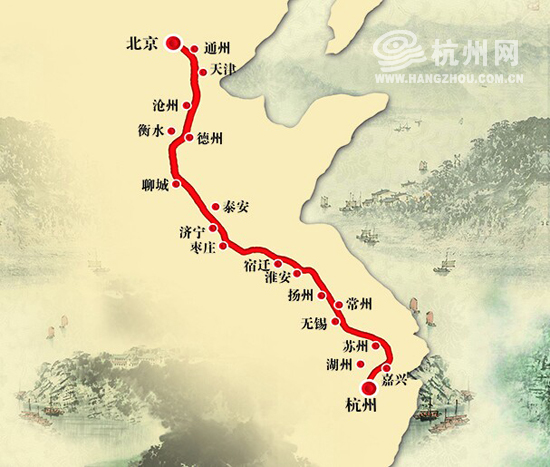
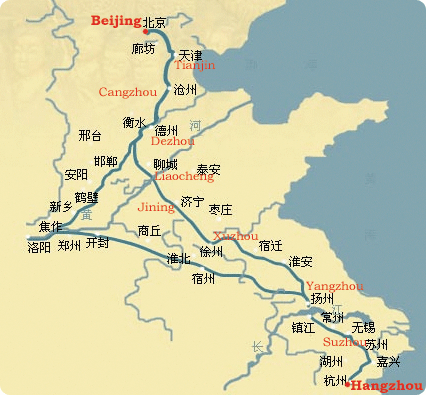
    We go to the ferry terminal that takes us on the Grand Canal from the center of Hangzhou to the Grand Canal Museum, another massive building, with great innovative spaces inside that include designs and models of the Grand Canal, as it existed once and as it is planned again, one long connection between Hangzhou and Beijing. Displays recreate the history of its construction and development, and if one could read Chinese, perhaps the  lives of the millions who sweated and died digging it out is discussed. Statues stand of the kings and engineers who envisioned the Canal, and I did see a display that showed sanitized laborers working, but did it mention the millions of individual human lives that were lost?

    Nothing is in English, so not reading Chinese the details escaped me, but because I was already familiar with the rich history of the Canal, I was able to appreciate much of the matter.

    The curator of the museum is young and bright and smart and elegant, altogether an impressive powerhouse of a young woman. If this is China today, watch out. Professor Shen had known the former curator, a man, but if China is seeking bright young progressive talent, they surely have found it in this young woman. Professor Shen introduced himself to this new curator and showed her our China 1908 photos. The curator and her assistant both studied the printouts and took some snapshots of pages and told Professor Shen that they wanted to discuss with their staff the possibility of an exhibit in the museum.  We were shown the room in which the exhibit might be held. We will learn what they decide after their next staff meeting; the exhibit would be a year away. 

    The ride on the Canal had little to do with what is in the photos of Clarence and Sidney Gamble, naturally enough, other than some stonework on the retaining walls. Most of what we saw on the banks of the Canal was new and orderly and smacked of Chinese gentrification, until nearer to the Museum terminal a few houses from the 40s or 50s line the banks. Real estate today worth millions, no doubt. Lucky families who held on to those properties for half a century.

    But as everywhere in the two China cities we have seen, most everything is new. We saw one old stone bridge on a smaller city canal leading into the Grand Canal, only one. The two bridges outside the Grand Canal Museum are concrete reproductions.

    After this, we walked across the concrete bridge and saw more museums, briefly strolled through the Hangzhou Arts and Crafts Museum, where English translations were in front of the displays but chose to forgo the many other  museums. My head was too concerned with our immediate work. It is all interesting we will have to come back.

    And so we went to lunch. Great idea, and Professor Shen ordered a delicious lunch: deep fried pumpkin; shrimp, so sweet; crisp cucumber spears;  yuba  (Japanese name), a soybean protein roll; wonderful white soup, with dumplings  onion, cabbage , black fungus. The Chinese know how to eat.

    After lunch, it was almost easy to tackle the rest of the day, but it was very hot. We went to a restaurant on the edge of West Lake and sat outside with green tea and a dish of fruit: persimmons, jujube, grapes, and discussed and argued about, what else? Clarence and Sidney Gamble’s 1908 China photos. Professor Shen answered my many questions, and we considered additional notes to the photos.

    Into another taxi and a drive around West Lake: so beautiful, so crowded with so many people at its edges (not in the lake, thank goodness), but, oh, the throngs, the traffic, and the relaxed energy of people at play (or working at play), the ceaseless flow of people people people, milling smoking, laughing, strolling, filled with life.

    We drove past the finest restaurant in all of Hangzhou, an enormous Crystal Palace twinkling with thousands of tiny golden lights; and everywhere else more and more tiny bright golden lights decorating buildings and signs.  

    It had been very hot in the middle of the day. We had stripped off as many clothes as one could do politely, but in the evening it cooled down. The taxi brought us back to the Bokai Hotel. We went into the hotel, and Professor Shen disappeared into the night in search of a free bicycle and his one-hour ride in the dark to his home in Unit 10.