Tag: Hangzhou

  • 12 November 2015 Thursday    Ling Yin Temple in the Rain. Again

    12 November 2015 Thursday Ling Yin Temple in the Rain. Again

    杭 HANGZHOU 

    Thursday  12 November 1015

    So at seven in the morning, we are checking out of the hotel in Shanghai and arguing about whether to take metro (7 RMB, one hour and 20 minutes)  or taxi (200 RMB, one hour), when the desk clerk calls to another customer, “Your taxi is here.” And where was this customer going? To the Pudong airport.  And was he willing to share his cab? He was. What lovely synchronicity. It was the best taxi ride ever. The driver was in a uniform. He actually helped with the luggage. The cab was clean, and the ride smooth. How very very nice.

    The day continued to be full of surprises. My seat mate on the bus from Shanghai to zHangzhou had just arrived from a conference in Las Vegas. He spoke good English and knew Hangzhou well. He located on the map all the sites we were coming to visit, translated the kanji into pinyin; gave me a Mandarin lesson, and recommended the brand name of a good portable charger.

    In Hangzhou, early checkin was possible at the hotel, and the manager knew of a good bookstore where I could buy a present for Mr.Xue.

    We wanted to take the present to Mr.Xue, and the hotel manger called him (Mr.Xue does not  speak English) to ask if we could come to the Temple. Mr. Xue said it would be difficult for us to find him because we do not speak Mandarin And then the hotel manager offered to come with us and be the translator. 

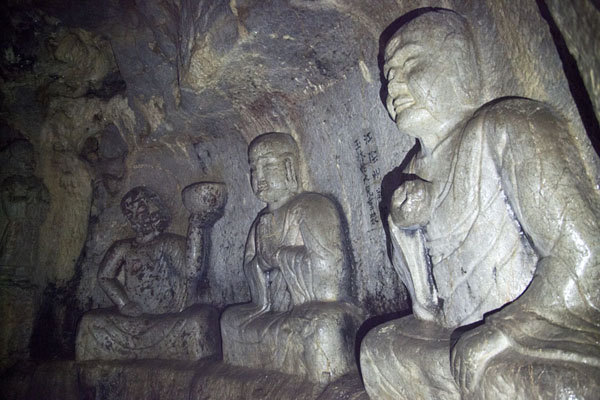
    So off we went, the three of us, driving around beautiful Westlake to Ling Yin Temple in the rain (it always rains when I go to a temple, but no matter, they give us umbrellas). After present-giving and tea-drinking and lengthy discussion of Clarence James Gamble and his LingYin photos, Mr. Xue took us on a tour (in the rain) of rock carvings that go back to the North Song Dynasty (960-1279): Buddhas carved in the nocks and crannies of the caves, big Budders and rows of little Buddhas, all sizes and so many. We splashed about and had to duck our heads under the down-hanging spits of rock. We used the flashlights on our smart phones to see the bas relief figures hidden in the darkness of the cave’s shadows. 

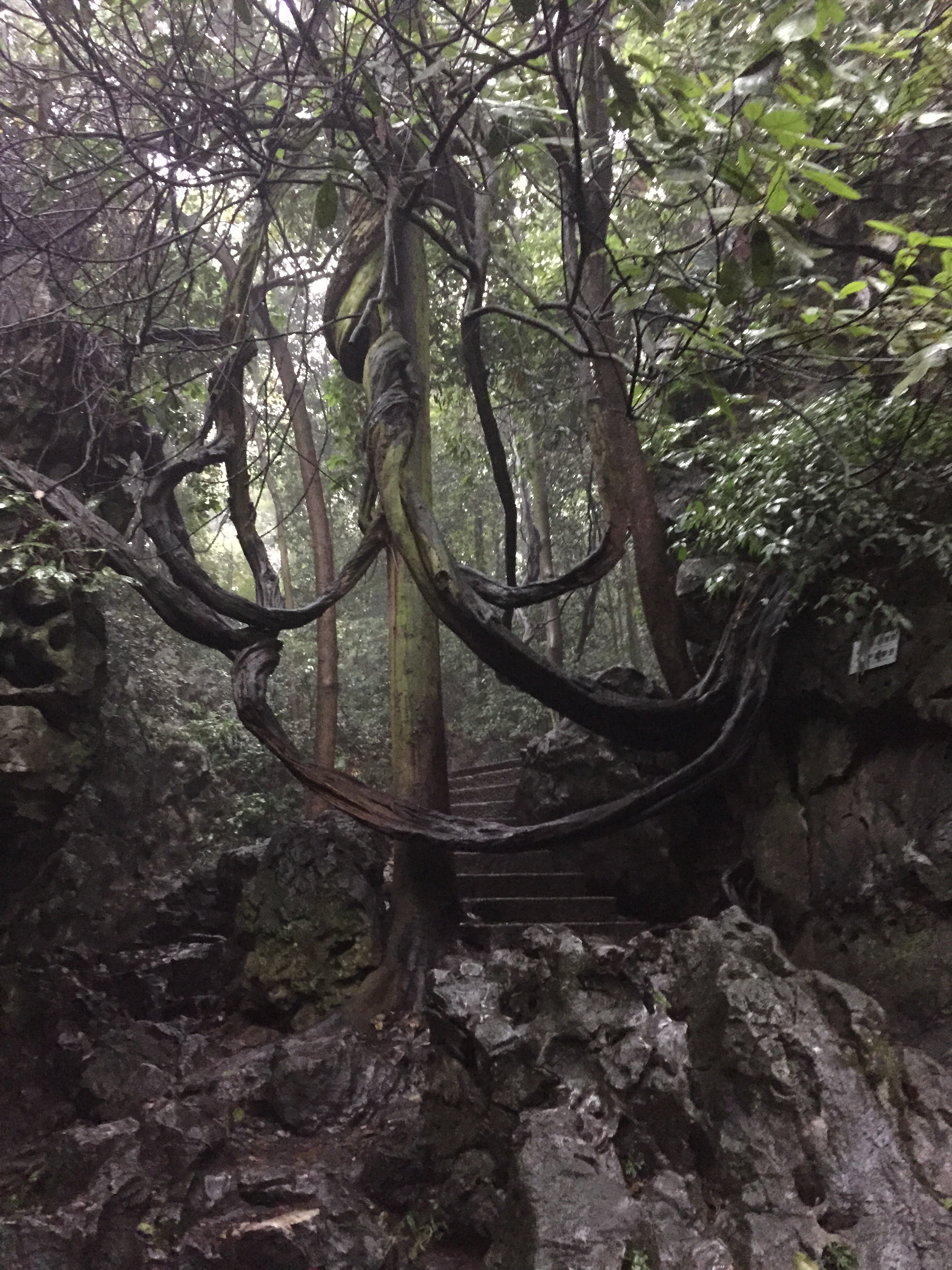
    2015-11-12 16.09.48

    I was so enthralled, I forgot to take photos. The featured photo in the header is what we saw as given on Wikipedia. But above is the photo that I did take just outside a cave: this tree had looped itself up and back and over. What was that tree thinking?

  • 5 November 2015 Thursday Grand Canal Museum & West Lake

    杭 HANGZHOU

    Thursday  5 November 2015

    Good Professor Shen arrived with taxi at 9:30. Off we tore into the traffic. I must look up the accident rate. How can these people not have an accident every block? But, no. Cars skim by each other, always within inches of each other. as do bicycles; scooters; small motor bikes; electric tricycles loaded with piles of lumber, long poles and 2x4s that poke perilously fore and aft the driver’s already overloaded load that sits next to behind his head. I saw very few buses, and no wonder. There is scarcely room for larger vehicles on many of the smaller streets. Small streets and boulevards and freeways are always jammed, not a finger’s width of space between bumpers. ‘and I am told Beijing is far worse.

    Two taxi drivers share a cab, twelve hours for each man. The car never sleeps. With Hangzhou and other incursions from upstarts, the certified taxi drivers are suffering, working harder than ever for less money. The certification involves a long study period and a stiff exam, but now, once acquired, the certification apparently does not ensure a good income.To drive twelve hours a day in this traffic would, I should think, leave the driver with an ongoing nervous breakdown, but, no – they keep on driving. 

    And the throngs of people to drive through and between and behind. We drove for what seemed hours through people and more people and more people, in that part of town people appear well-dressed and happy or even ill-dressed but happy. Outside our Bokai Hotel is an ongoing card game around a small table set on the edge of the sidewalk, overhung with a cloud of cigarette smoke, the onlookers and the players joking, involved, joshing; the participants vary, but the game goes on.

    The streets are so busy, people and scooters and cars always coming and going. And noisy, for the normal level of conversation is a shout, and the horn is a principle driving tool. Headlights on scooters and bicycles are seldom used. Crossing the street at night can be scary, for out of the darkness looms a scooter or a bicycle bearing down on you, no noise and no light to warn of its approach, 

    Construction and especially government reconstruction is everywhere, with bold brash monuments and huge bland public buildings that talk about power and massive stance and facelessness. All look somewhat alike, some tall and and some shorter and squat. Just as in much of Shanghai, Hangzhou is filled with endless clusters of identical pale condo towers, with addresses of units, buildings, areas, and streets given only in numbers. These buildings carry the same energy as the “Peace” Parade of last May, a heavy energy and inexorable power.
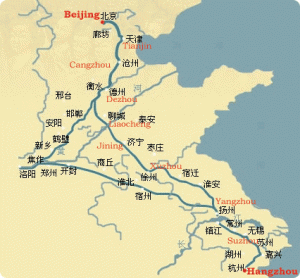
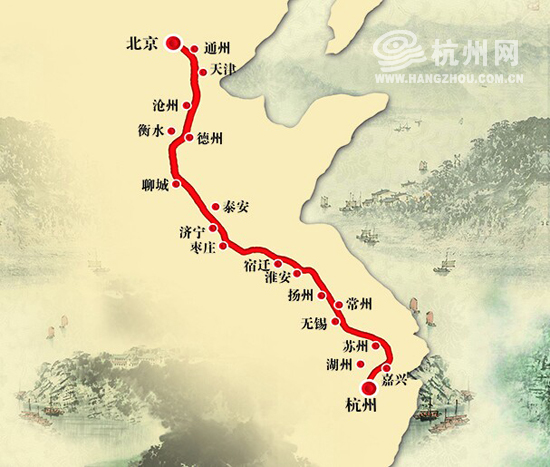
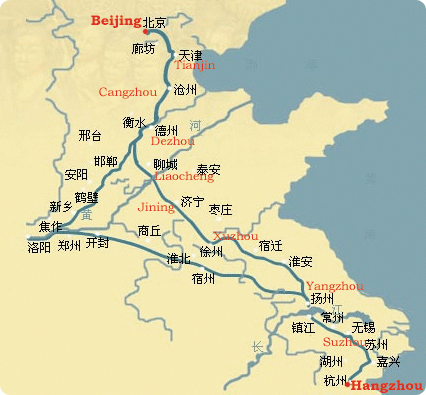
    Modern_Course_of_Grand_Canal_of_China_in_Chinese        china_grand_canal_map

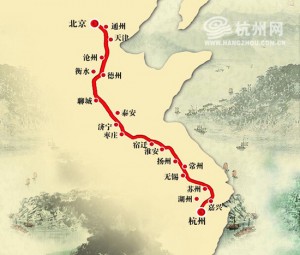
    We go to the ferry terminal that takes us on the Grand Canal from the center of Hangzhou to the Grand Canal Museum, another massive building, with great innovative spaces inside that include designs and models of the Grand Canal, as it existed once and as it is planned again, one long connection between Hangzhou and Beijing. Displays recreate the history of its construction and development, and if one could read Chinese, perhaps the  lives of the millions who sweated and died digging it out is discussed. Statues stand of the kings and engineers who envisioned the Canal, and I did see a display that showed sanitized laborers working, but did it mention the millions of individual human lives that were lost?

    Nothing is in English, so not reading Chinese the details escaped me, but because I was already familiar with the rich history of the Canal, I was able to appreciate much of the matter.

    The curator of the museum is young and bright and smart and elegant, altogether an impressive powerhouse of a young woman. If this is China today, watch out. Professor Shen had known the former curator, a man, but if China is seeking bright young progressive talent, they surely have found it in this young woman. Professor Shen introduced himself to this new curator and showed her our China 1908 photos. The curator and her assistant both studied the printouts and took some snapshots of pages and told Professor Shen that they wanted to discuss with their staff the possibility of an exhibit in the museum.  We were shown the room in which the exhibit might be held. We will learn what they decide after their next staff meeting; the exhibit would be a year away. 

    The ride on the Canal had little to do with what is in the photos of Clarence and Sidney Gamble, naturally enough, other than some stonework on the retaining walls. Most of what we saw on the banks of the Canal was new and orderly and smacked of Chinese gentrification, until nearer to the Museum terminal a few houses from the 40s or 50s line the banks. Real estate today worth millions, no doubt. Lucky families who held on to those properties for half a century.

    But as everywhere in the two China cities we have seen, most everything is new. We saw one old stone bridge on a smaller city canal leading into the Grand Canal, only one. The two bridges outside the Grand Canal Museum are concrete reproductions.

    After this, we walked across the concrete bridge and saw more museums, briefly strolled through the Hangzhou Arts and Crafts Museum, where English translations were in front of the displays but chose to forgo the many other  museums. My head was too concerned with our immediate work. It is all interesting we will have to come back.

    And so we went to lunch. Great idea, and Professor Shen ordered a delicious lunch: deep fried pumpkin; shrimp, so sweet; crisp cucumber spears;  yuba  (Japanese name), a soybean protein roll; wonderful white soup, with dumplings  onion, cabbage , black fungus. The Chinese know how to eat.

    After lunch, it was almost easy to tackle the rest of the day, but it was very hot. We went to a restaurant on the edge of West Lake and sat outside with green tea and a dish of fruit: persimmons, jujube, grapes, and discussed and argued about, what else? Clarence and Sidney Gamble’s 1908 China photos. Professor Shen answered my many questions, and we considered additional notes to the photos.

    Into another taxi and a drive around West Lake: so beautiful, so crowded with so many people at its edges (not in the lake, thank goodness), but, oh, the throngs, the traffic, and the relaxed energy of people at play (or working at play), the ceaseless flow of people people people, milling smoking, laughing, strolling, filled with life.

    We drove past the finest restaurant in all of Hangzhou, an enormous Crystal Palace twinkling with thousands of tiny golden lights; and everywhere else more and more tiny bright golden lights decorating buildings and signs.  

    It had been very hot in the middle of the day. We had stripped off as many clothes as one could do politely, but in the evening it cooled down. The taxi brought us back to the Bokai Hotel. We went into the hotel, and Professor Shen disappeared into the night in search of a free bicycle and his one-hour ride in the dark to his home in Unit 10.

  • From 海Shanghai to 杭Hangzhou

    海Shanghai  Tuesday  3 November 2015  

        IMG_0012-2               IMG_0006

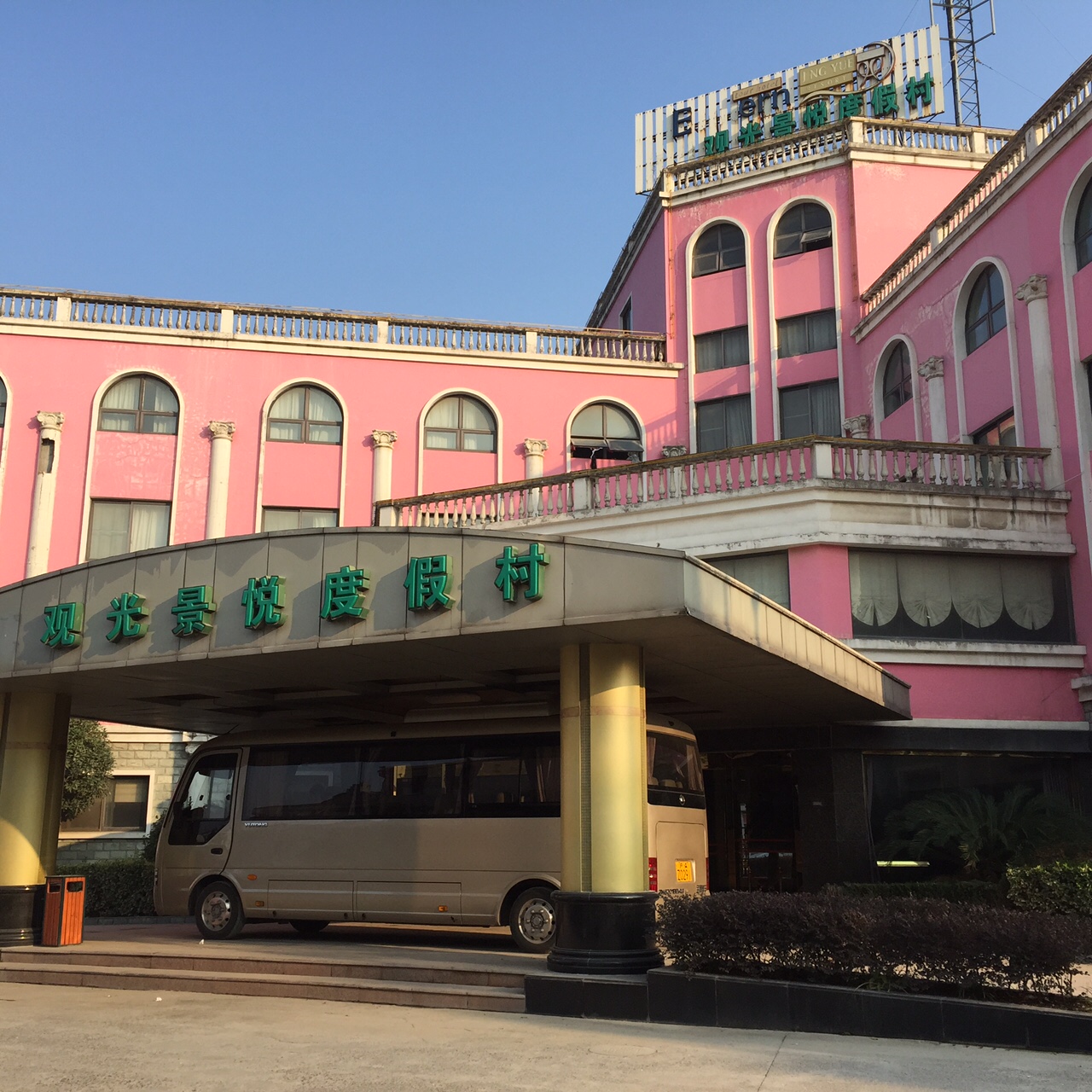
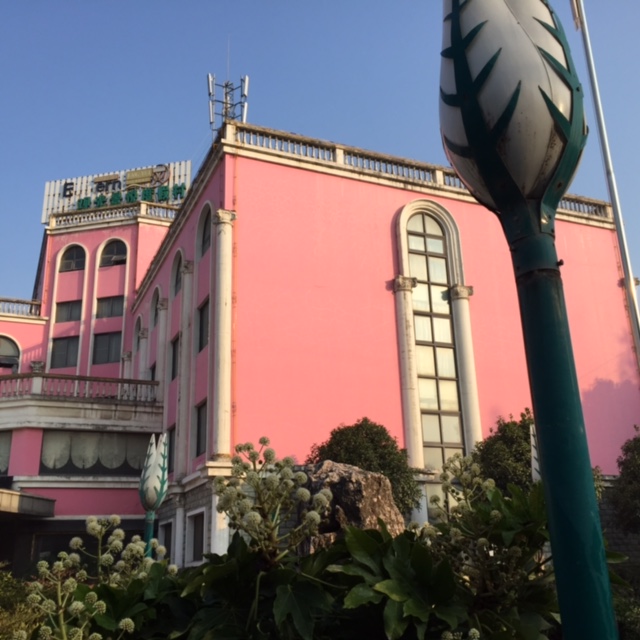
    hanghai, we stayed the night at a 3-Star hotel, whose outside walls were pink, bright  pink. Did I say the outside walls were pink? I have photos to prove it, but sending photos, let alone email, on this network is barely possible. Certainly, electronics are inexpensive enough to buy here. I discovered that I left my I Phone charger at the Jinyue 99 Hotel in Shanghai, but I paid only $22 for a replacement, which in the States would have cost $60 (nevertheless, I do not recommend losing your charger). But moving that electric content is another story. So far, I have not been on a fast network. Is there a Starbucks in China?

    Outside our very pink hotel, construction is seriously under way. My Apple I Phone 6 has a few changes I was not aware of, and, unfortunately, I lost my best photos: an ancient smaller truck, completely brown all over with rust, the noisy guts of the engine quite exposed, the hood doors  on either side long lost to time and age, completely missing, pistons (I guess they were) to be seen pumping and popping noisily – very noisily. Hard to believe that such a thing could be running. A great loss, that photo. 

    And the other photo: a two-wheeled cart perhaps belonging to a junkman, or maybe one who picked up recyclables, the cart piled much too high with plastic wrapped loads of who knows what that quite overwhelmed the cart and its driver.  Another great loss.

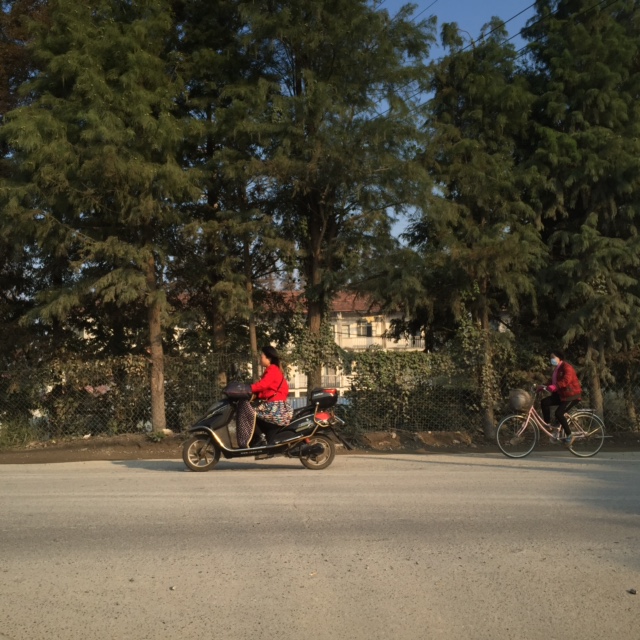
    Back to the serious construction. The road outside our 3-Star hotel was busy with cement trucks, the largest I have ever seen, charging up and back past the hotel on a road badly paved, dusty, narrow, its sides lined with rows of trees, piles of trash, and graffiti-smudged walls. 

                                                                 IMG_0021-2

    Talk about busy. The road just by the hotel comes off what must be a main thoroughfare, two lanes, one each direction. I made the mistake of crossing to the far sidle (somehow I reached the other side), and I am amazed that I am not still standing on the far side of that road twenty-four hours  later: a constant stream of  scooters and motorbikes and cars pouring from both directions. I watched carefully how a couple of  Chinese, who clearly knew what they were doing, made it across: by an adept art of dodge and sprint and, surely, prayer. I was to learn that there are relatively few traffic lights in Shanghai.

                                                                   Canal

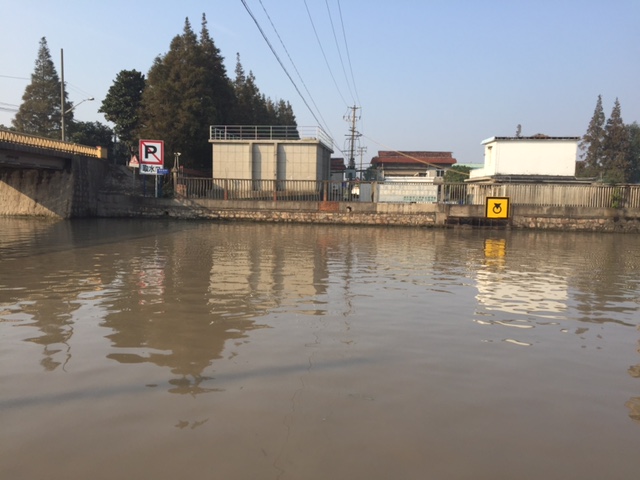
    We must have been in the old part of Shanghai. This was rural Shanghai. When we were driven to the hotel in the dark, I expected to be in a canyon of skyscrapers; but once we left the six and eight lanes of freeways surrounding the airport, we drove forever through narrow roads, poorly paved, lined on either side with tall dense rows of trees, some sort of evergreen, as I saw in the daylight. We were in a marshy area with many small canals; and in the morning, we were able to see these small canals, along with a larger canal, which runs alongside our hotel. Houseboats (another photo lost) were on the canal. The most interesting one had an old square, one-story wooden house sitting in the middle of its length.

    We took the bus to Hangzhou. The most boring  three-hour  bus ride ever, for nothing to be seen but large forests of identical condominiums, grouped in close spaces, with slightly larger spaces separating the one group from the next group; a few clusters of identical townhouses, obviously built just before Shanghai last doubled its population; and just a few two-story houses of post WW II development vintage.

    Once in Hangzhou, we hailed a taxi. I had carefully printed out the web page published by the hotel, but it was in  English, and I had not noticed that the kanji for the name of the hotel had not been included. Oh, dear. We piled into the cab, put our suitcases into the trunk ourselves (cab drivers seldom do that for you), gave the driver the sheet, and told him the name of the hotel. He scowled, looked at his GPS, and then said what were probably less-than-kind words and told us in universal terms to get out of his cab, immediately.

    Which we did. And then fortune favored us. A very bright cab driver called the hotel and delivered us promptly and received a very big tip. Do NOT, I repeat, do not come to China without knowing some Mandarin. Do learn more than I have been able to learn, but the few words I have learned have helped immeasurably. While the people at our hotel in Hangzhou have been most helpful (the manager speaks fluent English), many Chinese are distinctly disdainful of non-Mandarin speakers.

    We yearned for some dinner and found a restaurant that, we finally figured out, allows you to make your own soup. Trays of all sorts of vegetables, meats, condiments, are in a glass refrigerated case, two great vats of broth simmering near the doorway. The customer picks up a small basket, opens the glass doors, and with tongs, picks up bunches of what is to go into the soup to be cooked-to-order. Tsutae and I were slow to figure out exactly what to do, then slow to decide what to select. The owner said something rather curtly, and I replied in my best Mandarin, “I do not understand what you are saying.” He scowled more intensely and said probably the same thing the first cab driver had said, only something even more derogatory, and grabbed our basket from out of our hands. No made-to-order soup for us.

    It’s all part of the travel experience, is it not. We finally found some dinner, and the the restaurant owner was very polite. It was a good dinner, too.