Tag: travel

  • Seoul, Korea Saturday 16 November 2019

    Seoul, Korea
    Saturday 16 November 2019

    Three hours on the phone with Verizon and Apple takes up too much of the day. Wireless networks on two devices can be challenging to maintain.

    But finally, an interesting day in Seoul. Sunny as the day wore on and pleasantly brisk.  I am here near City Hall and the government buildings, so clearly this is the area for demonstrations. And my, do the Koreans know how to demonstrate.

    A very vocal group of Koreans do not like the current president. Most of the day has been filled with non-stop raucous racket, rants and anger spewed in lieu of coherent speech, marching bands that make more nose than music, chants and non-stop shouts that can be heard blocks away. An equal number of non-demonstrating Koreans are enjoying their day, drinking coffee (two or three coffee shops on every block), grazing on Western junk food, laughing and totally indifferent to the disturbing pervasive energy of the demonstrators. I have heard other demonstrations in Seoul where the speaker was rousing the followers with a Hitler-like formula, but what goes on all day here is quite different; a united crowd are not enthusiastically following a leader. Instead, everyone is apparently a leader and everyone has something to say and they asserted until well past dark.

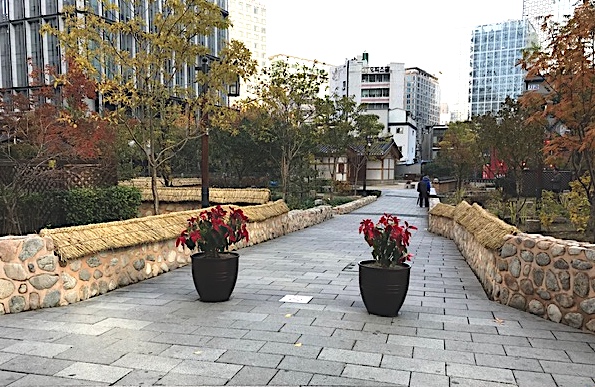
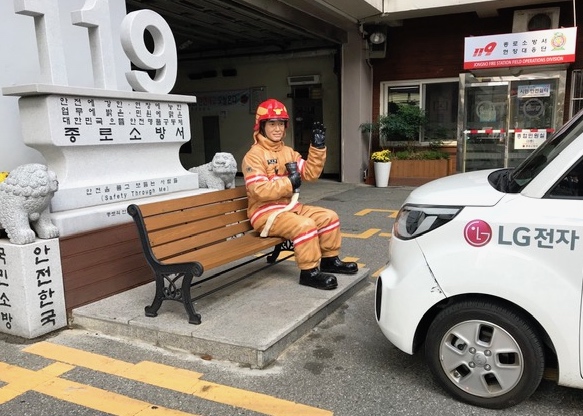
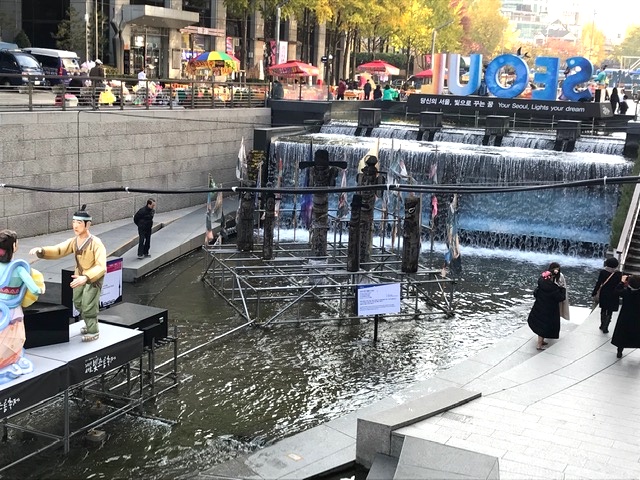
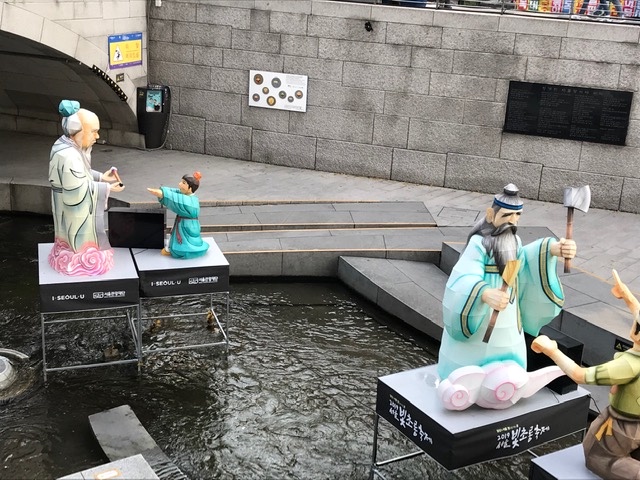
    Now that Sue is uploading the photos, you can see what the non-demonstrators are enjoying in Seoul: this curious water park, a gem of a garden, trees still with autumn colors, a bench to share with a ready-to-go firefighter.


  • Seoul, Korea Friday 15 November 2019

    Seoul, Korea
    Friday 15 November 2019

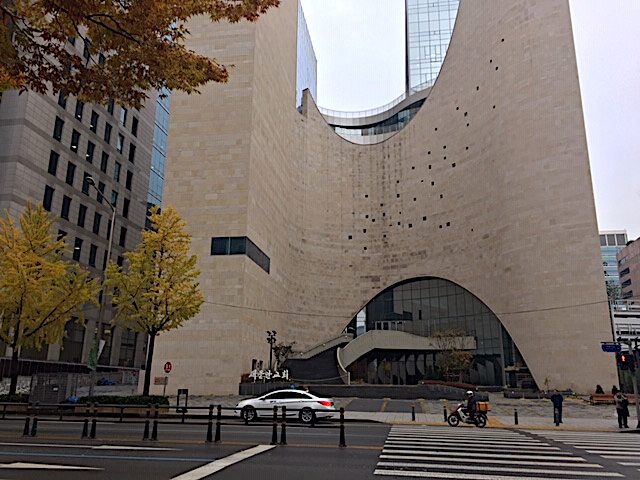
    For whatever reason, I found myself walking across the street from the Seamoonan Church, where a much better view was to be had. The photo gives an idea of this splendid architecture, but just as no printed photograph can capture the power of Van Gogh’s “Sunflowers,” no photograph can convey the beauty of this building. 

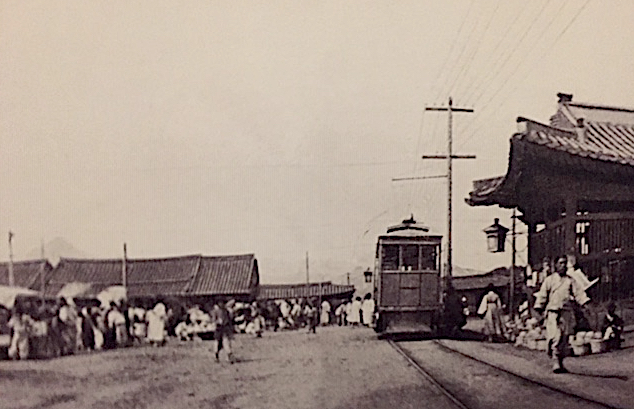
    The time was spent at the Seoul Museum of History studying their impressive permanent photograph and video exhibit of the history of the city. The photos and history of the years between 1882 and 1905-1910 are of especial interest to my research and are fun and charming: photos of receptions at the foreign legations, elegantly dressed ladies in nineteenth-century finery and bearded gentlemen with tie and vest; Western diplomats and various officials, bearded and unsmiling; the interior of American homes and foreign legations with turn-of-the century palms and period furnishings—and scarcely a Korean in sight. But also photos of newly installed streetcars and Western-style buildings alongside single-story Korean shops in wide, dirt roads. And finally Koreans wearing round black eyeglasses, which were the rage at the time.

    With the first arrival of the foreigners, particularly the Americans, who brought in the telegraph and the streetcar, electricity and newspapers, and the missionaries who were building schools and medical facilities, the time is good. But after 1905 and the signing with the Japanese of the Protectorate, it all becomes ugly. And uglier. After 1910, the Korean culture is steadily dismantled and the Korean people are peons in their own land, while the Japanese live the life of the conquering elite. Christians and nationalists, (the two regularly join forces) are targets for torture, imprisonment, and the most painful execution.

    So I happily resume study of nineteenth-century Korea, which is what “Korea 1908” is about anyway.

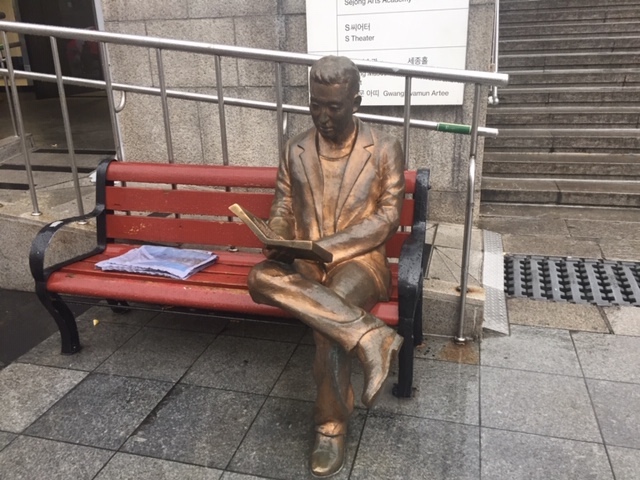
    Raining again. It does not disturb this Korean, who continues his reading. Note that I use the pronoun “he” because it is a man who is reading. Sorry, ladies.


  • Seoul, Korea Thursday 14 November 2019

    Seoul, Korea 
    Thursday, 14 November 2019

    The best things in life ARE free. The best things in life are the unexpected happy surprises.

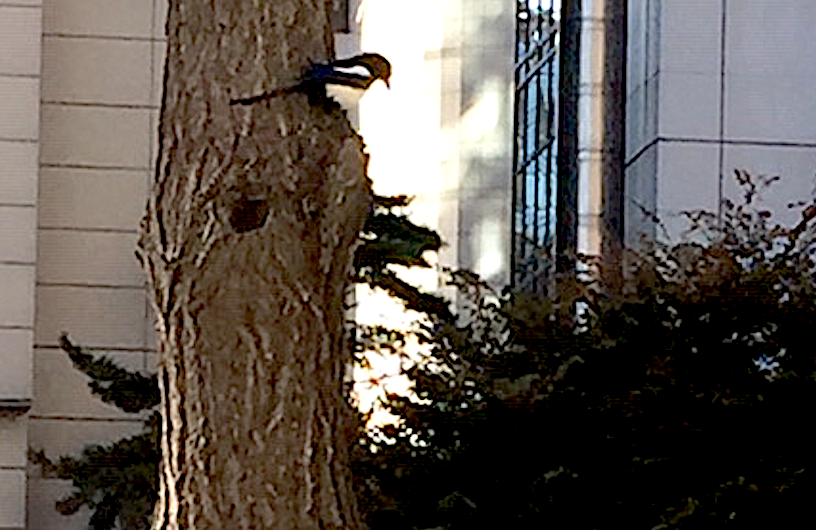
    The first surprise of today was a strange clattering sound that I heard while walking down a quiet street (another surprise—most streets are not quiet) in Seoul. At first, I thought it was some kind of strange machine. I stopped and listened and then wondered if it was possibly a bird, and then I saw a beautiful black and white bird, a bird between a crow and a blue jay (if blue jays were black and white instead of blue and white) in size and bawdy vocalization. I took a photo, but bird was not particularly cooperative and kept flying behind a tree.  From the racket, I thought it was a flock, but the flock seemed limited to maybe four members, all engrossed in some flight and chatter one-upmanship that marks any sort of a community and so noisy.

    Tonight I learn from my Korean friend Lia that these are magpies and to hear them brings good luck!        

    The second surprise came walking on a less quiet street in Jung-no on my way to the Seoul Museum of History. Suddenly appeared before my eyes the most marvelous sweep of brown sculpture that swooped from side to side in a great concave wave, even while soaring with either end point upward and skyward. Words cannot do it justice, nor even were I able to upload the photo would its splendor be apparent. It has to be seen. The building was completed in March, designed by Choi Dong-kyo and Lee Eun-seok of Seoinn Design Group, and received the Architecture Master Prize of 2019.       

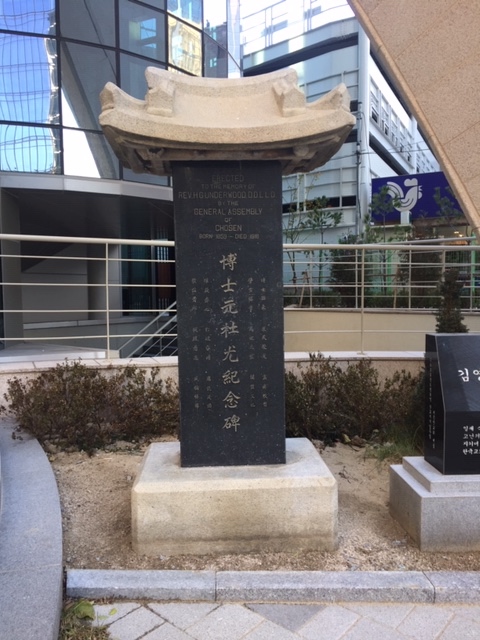
    Underwood Memorial

    Surprises continued. Saemoonan Presbyterian  Church of Korea, was founded in 1887 by Horace Underwood, the Presbyterian missionary who arrived in Korea in 1885 and not incidentally one of the missionaries of my research. Underwood was one of the first missionaries to arrive in Korea, organized its first Christian church (Saemoonan Church), established its first orphanage, compiled an English-Korean dictionary, a leader in church organization until his death in 1916. Saemoonan Church joined religion with patriotism, and Rev. Cha Jaaemyeong was removed from his office by the Japanese because he refused to bow in worship of the Emperor. Daemoonsan Church is the Mother Church of Presbyterianism in Korea; the image of mother inspired the architects in their design of the church building.

  • Seoul, Korea Wednesday 13 November 2019

    Seoul, Korea
    Wednesday.  13 November 2019

    Our generous professor gave me about three hundred dollars worth of scholarly (his) books at our meeting, so my reading time is predetermined. In the meantime, I had to locate a dry cleaners. The Korean Tourist  Bureau is extremely helpful, and indeed, they located a dry cleaners nearby. It was barely raining when I set out, and I did not bother with an umbrella, so determined was I to have a dry-cleaned sweater.

    I was given written directions and the exact address of the dry cleaners, but the welter of business-announcement signs—capitalism runs rampant here—rendered my written directions of little assistance. By this time, rain was coming down more intensely. Somehow, I stumbled into the correct commercial building, and a smiling Korean at the front desk read my note and listened to my request: Dry cleaning?  In Korean, “dry cleaning” is “dry cleaning.” “Shopping” in English is “shopping” in Korean. Very convenient. Koreans use many unadulterated English words. But that doesn’t make it easier to locate that which the word signifies.

    Either the smiling Korean door person hated foreigners or felt I needed exercise. He waived me out the front door to the entrance just outside of a flight of stairs and pointed. The dry cleaners—he had understood “dry cleaners”—- were in the basement. And so down I went, and down, and down narrow basement stairs that descended six stories below ground level. The dry cleaners was on the first basement level, at the bottom of six levels. I unknowingly stepped out of the stairs at the second basement level. Decades passed while I searched throughout the wrong level before I understood my error. Hours wandering past restaurant after restaurant, a Burger King, some very nice restaurants, a Thai massage parlor, a graphic design shop, more and more restaurants, all obviously thriving, all side by side, warrens and warrens of small restaurants and apparently the same many restaurants on all of the other six levels. Certainly the same on the first level, where the dry cleaners was finally located. How can they all thrive? Doesn’t anyone cook at home?

    Hours devoted to mundane maintenance leave little time for scholarly research.

    I took an elevator up from the lowest basement to street level. I walked home in serious rain. The waterproofing in my boots gave out midway. Swirling in the wind and rain, yellow leaves were falling like snowflakes artistically patterning the gray sidewalk.

    PS  Lots of photos in my album but no way to upload them.App incompatibility? Updated program hates me? Who knows. Very disappointing.


  • Seoul, Korea Tuesday 12 November 2019

    Seoul, Korea
    Tuesday  12 November 2019

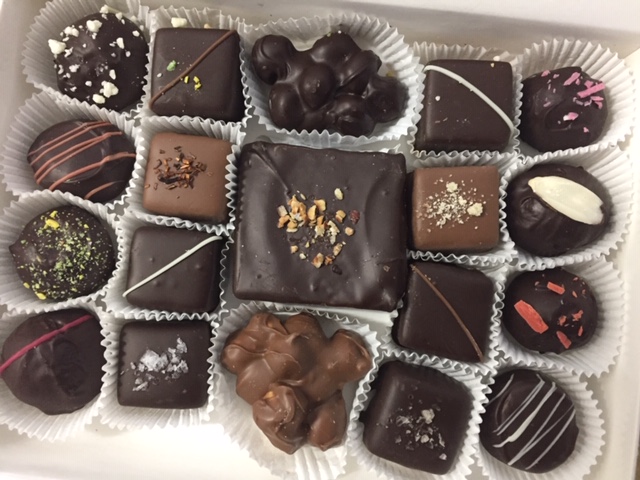
    Today, we visited the $40-chocolate expert, a professor at Yonsei University, and he was well worth the $40 and then some. Learned all sorts of things and was informed of all of my typing errors (very painful—it is a draft!) but many improvements and new material offered for “Korea 1908”—and answers to questions I had no way of locating.  He vetted only the first half,  and next Monday we return for additional information. For “Korea”1908,” this trip has proved invaluable.

    We went first to Severance Hospital, a glass-and-steel white  behemoth that extends skyward farther than the eye can see; within an equally white Christmas tree and Christmas decorations were arranged. Outside were more naturally colored flowers, so many, photos that I forgot to take. The temperature here is surprisingly mild and today sunny. Just below the Hospital building is another towering white behemoth, headquarters for the War on Cancer, obviously sustained by unimaginable sums of money.

    It is interesting the extent to which something can grow from a small act and one person’s vision. The Methodist Episcopal Church had become involved in missionary work early in the game, and their Woman’s Foreign Missionary Society had been supporting missionary work in China and Japan with scant evangelical success. Yet the WFMS of Revenna, Ohio, met regularly to champion the cause, despite any visible evidence of heathen regeneration. One “dear old lady,” whose name and background story are not included in the records I have available, felt strongly, for whatever reason, that Korea should be a field of endeavor for the Methodist missionaries and, specfically, that the girls and women of Korea should be given care. She presented to the Society “a “small sum of money dedicated to God” that she wished to be a nucleus drawing sums sufficient to send Methodist missionaries to Korea. Only one year later, Mary F. Scranton was appointed to the Korean field, and in June 1885, she reached Seoul. In Seoul, she opened a small school for girls that ultimately became Ewha Unversity, now the largest university in the world for women. From such small beginnings—and yet we do not even know the name of the “dear old lady.”