Category: Travel

  • 17 January 2017 Tuesday  Grand Canal Museum

    17 January 2017  Tuesday  

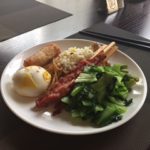
    Up at six, showered, packed, breakfasted (oh yes), ordered the taxi, and ready to meet Guang at the Grand Canal Museum. Not. An hour later, no taxi. Finally, my taxi arrives to take me to the museum, just as Guang’s taxi arrives to bring  her to my hotel. Why is that?

    We opted for the museum and met one of the individuals who had been involved in making the Grand Canal a historic site, who had written a wealth of books and taken as many photos on the history of the Grand Canal. Hit pay dirt and great contact.

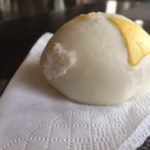
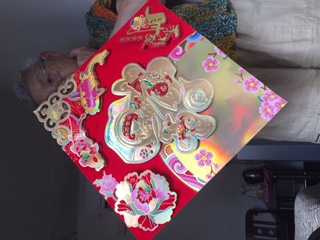
    Guang gave me this colorful New Year’s decoration that must be hung with the pointy side above the fish upwards, This brings good fortune and prosperity to the house that displays it. (The photo does not catch the details well; I am learning the limitations of the IPhone camera.) Looks closely, and you can see the little fish in the upper right. The large center figure is fu, which means “good luck.” The New Year’s greeting is “Fu dao  nien nien yao yu”  福到 年年有余. “May good fortune and prosperity come to you in the new year.” YU means “fish” and also “abundance.” DAO means “arrival” and “upside down,” which is why you turn the FU upside down to remind the viewer of the homonym and that in this case you are wishing to ensure the arrival of abundance. Is all that clear? Probably not. Chinese language is full of homonyms and subtle complications. I wonder if Westerners can ever appreciate the language.

    Back to campus and lunch and off to Professor Shen’s office. The campus is built on wetlands, and at its edge is a wetlands preserve Thus, the many streams and lakes that lie throughout its landscape, but more interesting was the bridge-walkaway we went over to reach the building that houses the International Center offices:  Large rectangular  pillars spaced apart but closely enough to reach with the next step. The pillars rise high above the water level, and I imagine the height accommodates changing water levels.

    The Hangzhou airport is a good hour away from Hangzhou, so I left the hotel before six by taxi (this time taxis were available). Asian airports are daunting. Big. Crowded Wall to wall to ceiling people. Someone spoke English, and I found the right line to wait in for my boarding pass.Then I waited in line to go through Immigration. Next, waited in line to go through security,  Ticketing began at 7:20; the plane left at 9:20. I pretty much needed all that time –  three hours – at the airport to prepare for the flight, plus the hour to get to the airport. Flying requires a great deal of prep time.

    Nor are flights for the tired and weary. The Chinese never seem to be weary. In America, the USA traveller finds a seat in the waiting area and pulls out his Smart phone or his computer or his book (only the older generation pulls out a book) and quietly absorbs himself in his interests, He may talk quietly with his neighbor, but generally, things are pretty low key  Not so in the Chinese waiting area. Everybody is interacting with everyone else in a very loud voice, The volubility continues as the Chinese wait in line to board. The Chinese are perpetually vocal and irrepressible. Everyone always seems to be at a party. “What is she saying? Why is she so angry” I asked Guang, when I heard the grandmother shouting at her grandson. “She’s not angry,” said Guang. Then I understood she was just being a normal Chinese person, speaking in a norma Chines voice. 

    The EVA flight was a delight. I flew cabin,economy, but the seats were roomy and  comfortable, as well as attractive. The cabin of the plane was beautifully designed. And the staff! Everyone dressed in sharply pressed uniforms performing in  a gracious, professional manner. Why cannot we have airlines like that in America? Flying EVA was a great experience, even though I landed dead tired and close to midnight.
  • 15 January 2017 Sunday Zhejiang University, Hangzhou

    15 January 2017  Sunday

    “Fifty errors” reported Professor Shen in the morning email. I blanched, and while working on emails, awaited his arrival for our late morning meeting with some trepidation. But it turned out that most of the problems involved Chinese characters. How can anyone learn Chinese characters?

    It was a workday all day, but with a delicious Chinese lunch, much needed to fortify one against the diddling editing demands. At the end of the afternoon, the fixes were fixed, except…. Except. Always one little “except,” this time a mid-level dot between two Chinese characters, whose location (oh dear) I have lost. Appalling, what keeps one awake all night.

    This was not the wonderful thing that was supposed to happen today, the wonderful surprise that I anticipated when I awoke.  On the other hand, a good day’s work saw the completion of Part Two of ”China 1908.”  Except for the damn dot.

  • 14 January 2017 Saturday Zhejiang University, Hangzhou, China

    14 January 2017  Saturday

    The morning was spent with Professor Shen assessing repairs to “China 1908,” offering a glimpse into all the things that I do not know and have yet to learn, such as – oh, dear, too many too recount. 

    The afternoon was equally congenial, because, in fact, Professor Shen is always interesting and exciting to learn from, and we did talk about “China 1908,” THE BOOK, which is my favorite subject, but then the afternoon also took me away from the computer to outdoor research on The Book, for my friend Huapin Shen drove us to the Liuhe Six Harmonies Pagoda. That sentence is too long.

    At the entry to Liuhe, we saw a poem, which liberally translated, instructed one to enjoy the sound of the moving tide while at Liuhe pagoda. This is appropriate. The Liuhe overlooks the broad and beautiful Qiantang River, so important to China’s history, for the Qiantang, once connected to the Grand Canal, brought ocean-going traffic and cargo all the way north to Beijing. In 1908, the six sedan chairs of Robert Fitch’s outing for the Gambles were parked near the base of the Liuhe Pagoda, while the chair occupants were exploring the site of the future Hangchow Christian College campus. “The children got nicely wet  and dirty in the sand,” reports Clarence in his Journal for that day in 1908. He writes little more about the campus site, for there was little more to write. Sand there was (no wonder the children got “wet and dirty”), and sand was all there was.  The area had long been denuded by aggressive lumber merchants. 

    After construction of the major college buildings was completed, with money from the Gambles, among others, students and faculty in the early twenties planted the hillsides extensively, and today the site is a veritable garden-park. The students of the Law Department of Zhejiang University, who now use the buildings, have a lovely setting in which to study, though more likely, to party. We are, after all, talking about college students. Nevertheless, the Gambles would be delighted to know that the buildings are, to this day, in service.

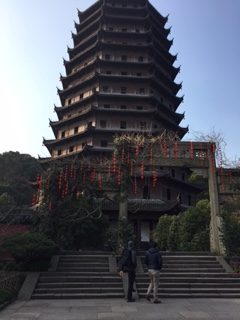
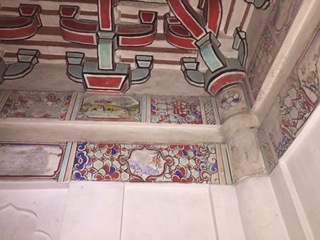
    The original Liuhe Pagoda was built in 970 AD, but the current reconstruction with its slanting floors was built during the Qing (1643-1912) Dynasty  Within, the steps that take the visitor to the top of the structure are, as expected, worn, steep, and uneven. The feet of those eighteenth-century monks must have been very small, for the steps are narrow; feet need to go sideways on them. Surely, the walls have been re-plastered. They are bare and whitish, and unless you know to look, you will never see what was once brightly colored artwork tha enlivens only the ceilings of small rooms around the center of the pagoda. Michelangelo it is not. Colors have obviously faded, but colorful geometric designs can be seen. What kind of monks painted these? 

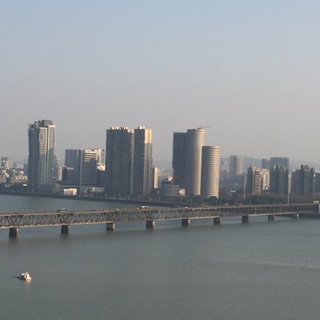
    From the window openings of the pagoda, the view of the broad Qiantang River is beautiful. Through the mist, on the opposite bank, we saw towers of apartments and offices; the taller the tower, the more recently it was built, In the fall, the famous Hangzhou Bore, the largest in the world, courses past the Liuhe Pagoda, to reach historic heights where the river reaches the sea. Its rising beginnings are to be seen from the Pagoda, as are the daily tides, to which the entry poem refers. Every day, the boats, usually tied to the docks edging the river, draw to the river center to avoid crashing sides against the docks with the movement  of the tide. We were there at just the right time to see the afternoon movement of the tide. We watched as the boats waited with great anticipation. It was, unfortunately for those of us who love drama, a very low tide on that cold, cloudy, intermittent sunshiny winter day, and all to be seen were some wide swaths of gentle swells. We did not hear anything, but we can say we saw a little something.

    After the anti-climatic tide-viewing, we clambered down those steep, narrow, irregular steps and into the gray courtyard.  A plaque proclaimed a monk who begged alms for ten years before he had sufficient funds to rebuild one of the many Liuhe econstructions. For that dedication, he, no doubt, enjoyed great satisfaction in his soul and earned, as well, a larger-than-life statue that sits before a great rock bank beside his plaque.

    Viewing completed (oh yes, Huapin, also rang the gong), we went to another hill, to Siyanjing (translates Place of Four Wells), where rustic restaurants and student hotels are jammed into the hillside and into each other, and where the parked cars are jammed into each other. The road curving up to SIyanjing is extremely narrow and, curiously enough, a two-way street. I have no idea what happens when two cars meet each other. China drivers drive slowly and very, very close to one another –  centimeters (millimeters?) within each other. There never seem to be any accidents, no doubt because driving is not fast, but I felt a lot of breath-holding moments as fenders skim by each other with a hair’s breadth between. So different from America, where a stretch of road means “speed up,” but individual cars will always demand a large personal zone of space around them, if it is 


    Lithe Pagoda
    Painted Ceiling
    Across Qiantang River
    Hitting Gong

  • 13 January 2017 Friday Zhejiang University, Hangzhou, China

     13 January 2017 Friday

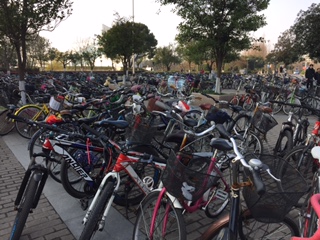
    BIG. It is all so big. Here, in the northwest of Hangzhou, Zijingang Campus of Zhejiang University is big and still being built. Zijingang Campus is one of the five that comprise Zhejiang University, which is one of the three most important universities in China. The streets running through the Zijingang Campus are wide with a green median. To accommodate the distances for the approximately 10,000 students, bicycles are everywhere. Students can use free bikes that are available around the campus, pick up at one spot and deposit at another, and get to class on time. All they need is the password to unlock and go. The student cafeteria is The Largest in Asia. As the Chinese say, Min Yi Shi Wei Tian 民以食为天 , Food is as important as the sky above.

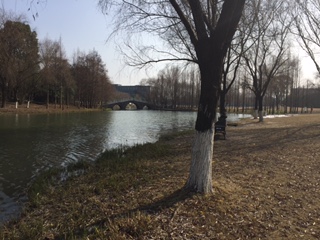
    Throughout the campus, stretches of brown where green grass will come in the spring surround a wide stream that winds through the grounds. Ducks, geese, and swans, black and white, enjoy the stream on this comfortably cool day. As do grandmothers with their single charge, students with cell phones (whatever happened to students with books?), infatuated heterosexual couples (did not see homosexual couples or obvious singles), and purposeful striders. These and others dot the brown and go over the graceful bridge with gentle-height steps, just perfect for casual walking. The water, too, is brownish on this brownish-gray day, but the sky is blue and we have sunshine. Last week in Hangzhou, it was daily rain, just as in Ashland, but without the ice. 

    The campus buildings are big, as might be expected, and display that same breadth and spaciousness that so impressed me when I first entered Pudong Airport in Shanghai. This time, I did not come into the main terminal area, where the down-pouring, angled ceiling rods, which could feel threatening, only serve as interesting visual stimulation. This time, I simply had my nine-minute sprint through endless corridors to the Long Distance Bus that brought me into Hangzhou at midnight and left me with severe shin splints today and tonight. 

    Even though buildings are often designed today by international architectural firms, I cannot imagine the buildings that I saw on the Zijingang campus being in America, although perhaps that is a subjective projection. I am, after all, here, in China. Perhaps the necessity for conformity bred into the Chinese for 5,000 years keeps the spaciousness somewhat grounded, still spacious but less airy than what I see in America. In America, space can be fussier and bristle on the edges with individual bursts. The newer buildings in China, as opposed to the massive behemoths of the Mao years, seem to insist on the limitless possibilities that await the Chinese.

    Yet, I met a woman here, who in addition to full-time work and the supporting activities that her important job entails, must cook dinner every night for her in-laws. Her mother-in-law often criticizes her, and she must ensure that her mother-in-law is always accompanied when going out. We have all heard stories of Chinese mothers-in-law. Mary Gamble met such a mother-in-law on the 1908 China trip and insisted that Clarence, in his China Journal, recount the ferocity with which this woman spoke to her several daughters in law. “Fierce in every word she said,” writes Clarence, as instructed. But that was in 1908. This is over a century later.  As an American, it is impossible to comprehend, “Viva la difference!”

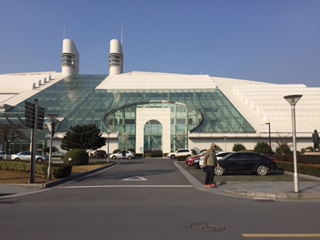
    But back to Zijinggang campus buildings that were built in the nineties. The Architecture Department Building is a logo for the University, and,unique as it certainly is, deserves logo status. A great whitish building, it stretches parallel to the street in a variety of patterns on either side from its center (I think that must be its center –  a brief area on the roof flanked on either side by horns? funnels?smokestacks without smoke? From a distance, the two “horns” recall the heads of horses rising up and charging over the edge of the building. Inside skylights and great space. .

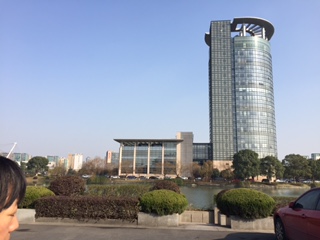
    The striking tower across the way has so many changing facets, a half circle in shape with a flat back and a half circle of spokes at the top. On the bottom floors are the library. Four floors up is a coffee shop with surrounding garden and pool with goldfish on an outside deck. Hard to believe you are several stories above ground. Farther stories up are administrative offices, and the view from the penthouse must be wonderful. 

    Despite my concern over Premier Xi’s hard line, my friend Guang Ding, who teaches English at the University (of course she teaches English, for how else can I know anyone in China – oh to learn Mandarin in my spare time) has been studying the Moule missionary family, British, but apparently of French extraction with a surname like Moule, She spent a year researching at Cambridge, and now Guang has received a government grant to continue her work on this Christian missionary family, of which among its fourteen members, most deserve to be written about. Her particular Moue subject took many photos of the Hangzhou of his time and wrote about early Hangzhou history extensively. Her Department is immensely proud of her, and it does much to say that, hard line or not, the Chinese government is supporting the humanities and the study of the history of Christian activity in China. “Publish r Perish” is alive and well in China academia, and the demands on the non-tenured are, as always, immense  Guang and I talked at length about Nineteenth-century China history, the place of Christian missionaries in it, the possibility of her writing articles that refer to and use my Gamble material. We learned a great deal from each other.

    My room is delightful. The outside wall is one glass window, allowing light and a great view of this campus and of the almost-skyscrapers across the way. At night, only a a few streets lights, soft golden globes, can be seen along the sidewalk below (I am on the seventh floor). In the quiet of the night campus, the dark is easy and restful. Blackout curtains are not needed. Within the room, the heat comes on, emitting a coarse breathy sound, as though you are sharing the room with a heavy breathing monster, invisible but assuredly in your midst with its gurgling, regular panting. Since the monster is invisible, he is not threatening.

    A Fine Friday The Thirteenth. No overbooked airplane. Just some shin splints.

    Library & Administrative Tower
    Stream & Grounds
    Campus Bicycles
    Architecture Department Building